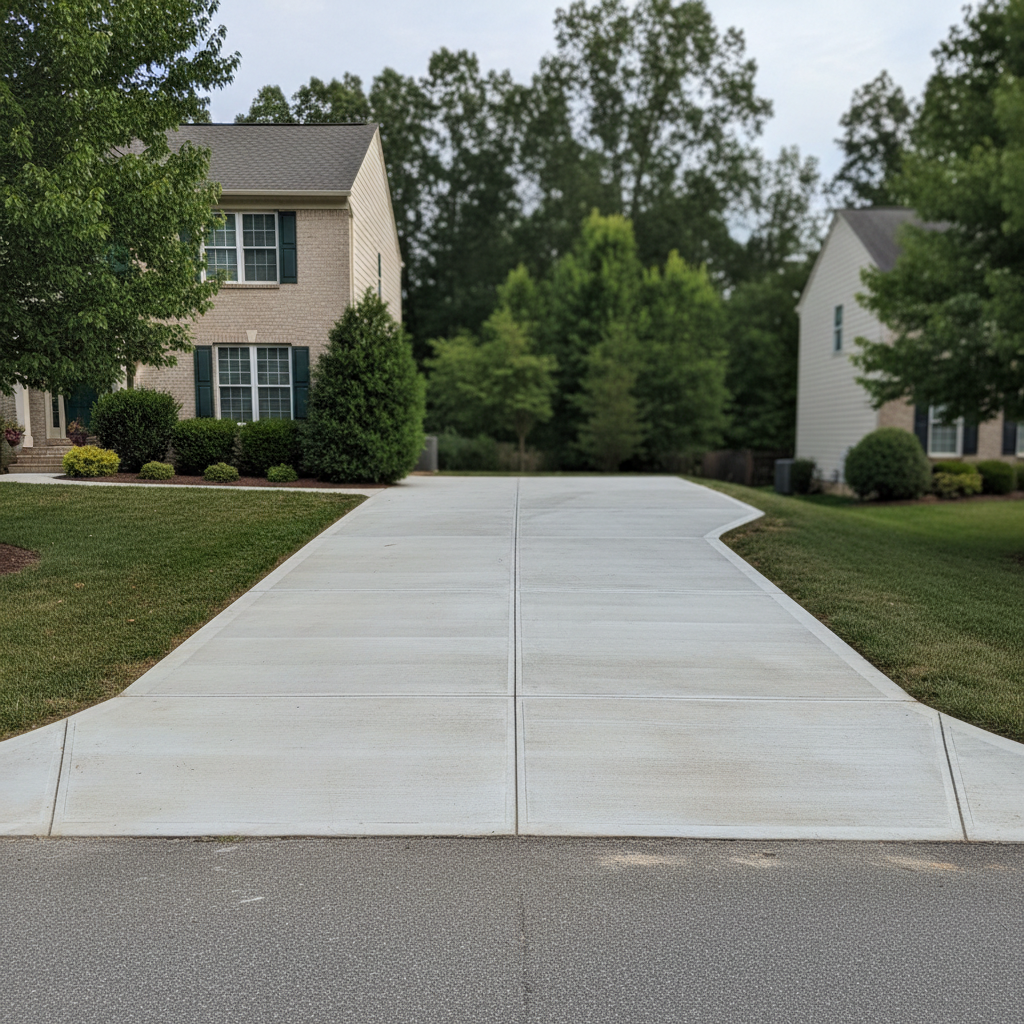
Concrete work looks simple from the driveway. Pour it, let it sit, drive on it. The part homeowners don't see is everything that happens before the truck shows up, and that's where most bad jobs start. If you're getting quotes for a driveway, a patio, a repair, or anything else poured in this trade, here's what actually separates a contractor who knows the ground here from one who's just forming up boards and hoping.
Start with the license and the insurance, not the price
Maryland requires a Home Improvement Commission license for most residential concrete work over a certain dollar amount, and Montgomery County has its own contractor licensing on top of that. Ask for both. Ask for proof of general liability insurance and worker's comp, and don't take their word for it, ask them to email you the certificate. If a contractor hesitates or tells you "we've never needed that," that's your answer. A cracked slab is annoying. An uninsured worker hurt on your property is a different problem entirely.
Price matters, obviously, but the lowest bid on a concrete job is almost never the cheapest one over five years. A thin slab poured over loose fill will crack before a properly based one, and then you're paying for the repair plus the original job.
What they should be asking about your soil, not just your square footage
Germantown sits in the Piedmont, which means a lot of lots here have red clay topsoil over schist or other bedrock, sometimes just a few feet down. Clay swells when it's wet and shrinks hard when it dries out, and that movement under a slab is one of the main reasons concrete cracks or heaves unevenly. A contractor who's done work around here should know this without you bringing it up. They should also be asking about drainage on your lot, because a lot of the newer developments off Father Hurley Boulevard and Observation Drive were graded for stormwater management, and cutting into that grading wrong can send water toward your foundation instead of away from it.
Good prep looks like this: excavate down to stable subgrade, compact it, then lay 4 to 6 inches of crushed aggregate base and compact that in lifts, not all at once. Skipping the compaction step is invisible once the concrete's poured, and it's the number one reason slabs settle unevenly a year or two later.
Thickness, reinforcement, and joints — ask for the actual numbers
A patio or sidewalk is typically poured at 4 inches thick. A driveway that'll see regular car and truck traffic should be 4 to 6 inches, with 6 inches being standard if you've got anything heavier parking on it. Ask whether they're using wire mesh or rebar. Mesh is cheaper and fine for lighter slabs, but rebar tied at 18 to 24 inches on center gives you more strength where the soil movement is worse, which matters more on a clay lot than a sandy one.
Control joints matter just as much as the mix. Concrete is going to crack somewhere, that's just what the material does as it cures and shrinks. The joints give it a place to crack where you won't see it. They should be cut within 24 to 48 hours of the pour, spaced roughly 2 to 3 times the slab thickness in feet apart. If a contractor's plan doesn't include a joint layout, or they're cutting them a week later after the slab's already decided where to crack on its own, that's a sign of a crew that's rushing or guessing.
Weather and timing, because this isn't Phoenix
Concrete needs to cure, not just dry. Full strength takes about 28 days, though you can usually walk on a slab after a day or two and drive on a driveway after about a week, depending on the mix. Summer pours in July and August, when it's humid and 90 degrees, cure fast on the surface and can crack if the crew doesn't keep it moist with curing compound or wet burlap for the first few days. Winter is the other end of the problem. The DC area gets somewhere around 30 to 40 freeze-thaw cycles a year, and if concrete freezes before it's cured enough, the water inside it expands and the slab is compromised permanently, not just cosmetically. A contractor working here from November through March should be using cold-weather additives or insulating blankets, and should be honest with you about whether a pour needs to wait for a warmer stretch. If someone tells you winter temperature doesn't matter, they either don't know or don't care.
Permits, HOAs, and what Montgomery County actually checks
Most driveway and patio work in Germantown goes through Montgomery County's Department of Permitting Services, and depending on size, a new driveway or a large patio addition can trigger a review for impervious surface and stormwater, especially since a lot of these neighborhoods already have stormwater management built into the original site plan. A decent contractor pulls the permit themselves, or at minimum tells you clearly that you need to and walks you through it. They should also know that neighborhoods like Kingsview, Churchill, Clopper's Mill, and Gunners Lake Village have active HOAs with their own rules on driveway material, patio placement, and sometimes even color for stamped or decorative concrete. Skipping that step doesn't save you money, it just moves the problem to after the concrete's already poured, when fixing it costs a lot more than asking first would have.
Older streets closer to the original Germantown town center, versus the subdivisions built through the 80s and 90s further out, come with different buried surprises too. Septic lines, old well caps, utility runs that were never mapped well. Ask whether the contractor is calling Miss Utility before they dig, which is required by law in Maryland anyway, but worth confirming out loud.
Get it in writing, and walk if they won't
A written contract should spell out thickness, reinforcement type, base prep, the concrete mix or PSI rating, and a timeline, including what happens if weather pushes the pour back. It should also say who's responsible for cleanup and what the warranty actually covers, meaning cracking beyond the normal hairline shrinkage cracks every slab gets. If a contractor wants a large deposit up front, in cash, with no paperwork, that's not a deal, that's a risk. A fair deposit is common. No contract at all is not.
None of this is complicated once you know what to ask. It just takes someone willing to answer plainly instead of talking around it. If you're planning a driveway, patio, or repair and want straight answers about your lot specifically, that's the kind of conversation we have before Titan Concrete ever shows up with a truck.